The Chernobyl accident killed an estimated 28 people in the first four months. Due to high levels of radiation, there were 106 other workers who died in the first four months. Around 200,000 workers received radiation doses between 1 and 100 rem. Cleanup activities drew even more Soviet citizens to Chernobyl.
Most radiation spread into areas of Belarus, Ukraine, and Russia. There was a high frequency of cases of thyroid cancer and leukemia, although it was difficult to date them to the Chernobyl accident due to statistical issues, such as the sample size being too small. When Chernobyl accident happenned the USSR started a military run clean-up. Chernobyl liquidators were exposed to radiation, and became heroes in modern world.
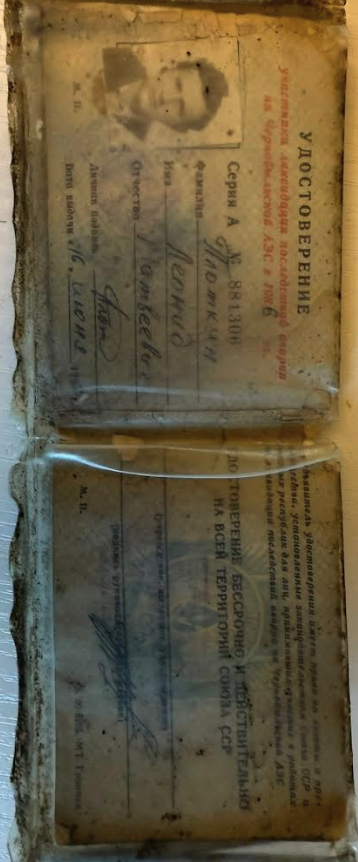
Soviet government documentation of participation in Chernobyl accident clean-up (1986).
The Chernobyl accident contaminated wide areas of Belarus, the Russian Federation, and Ukraine inhabited by millions of residents. Agencies such as the World Health Organization have been concerned about radiation exposure to people who were evacuated from these areas. The majority of the five million residents living in contaminated areas, however, received very small radiation doses comparable to natural background levels (0.1 rem per year) (UNSCEAR 2008, pg. 124-25). Today, the available evidence does not strongly connect the accident to radiation-induced increases of leukemia or other cancers, other than thyroid cancer. Many children and adolescents in the area in 1986 drank milk contaminated with radioactive iodine, which delivered substantial doses to their thyroid glands. To date, about 6,000 thyroid cancer cases have been detected among these children. Ninety-nine percent of these children were successfully treated; 15 children and adolescents in the three countries died from thyroid cancer by 2005. The available evidence does not show any effect on the number of adverse pregnancy outcomes, delivery complications, stillbirths or overall health of children among the families living in the most contaminated areas (UNSCEAR 2008, pg. 65).
There could be more significant consequences of this disaster. Thanks to Valery Legasov and his team, there was an immediate evacuation of the Pripyat region. Legasov also pioneered the use of sand, lead, and boron to stop a large fire, which was spreading radiation exposure. Many brave people sacrificed their lives to save a whole continent. After responding to the nuclear explosion, the condition of a firefighter was described as followers: “He was producing stool 25 to 30 times a day, with blood and mucus. His skin started cracking on his arms and legs. He became covered with boils. When he turned his head, there’d be a clump of hair left on the pillow” (Voices from Chernobyl, Svetlana Alexievich). The World Health Organization recorded the radiation exposure, which was estimated to be fairly low (around .1 rem per year [UNSCEAR]). No connection was drawn between any rise in leukemia with Chernobyl disaster, though European organizations did record an increase in rates of thyroid cancer — around 6,000 cases of children with thyroid cancer were reported following the disaster.
Experts expected that some cancer deaths might eventually be attributed to Chernobyl over the lifetime of the emergency workers, evacuees and residents living in the most contaminated areas. While cancer deaths have generally been far lower than initial speculations of tens of thousands of radiation-related deaths, a recent study of a cohort of emergency workers found a statistically significant relative risk of solid cancer incidence and mortality (Kaschcheev, 2015).
There are also psycho-social impacts on residents and evacuees from the disaster, including higher rates of depression, alcoholism, and anxiety over potential health effects. Residents report very negative self-assessments of health, unexplained physical symptoms, and expectations of a short life (IAEA, 2006; World Health Organization, 2006).